



Florida Hurricane Preparedness - What Every Homeowner Needs To Know
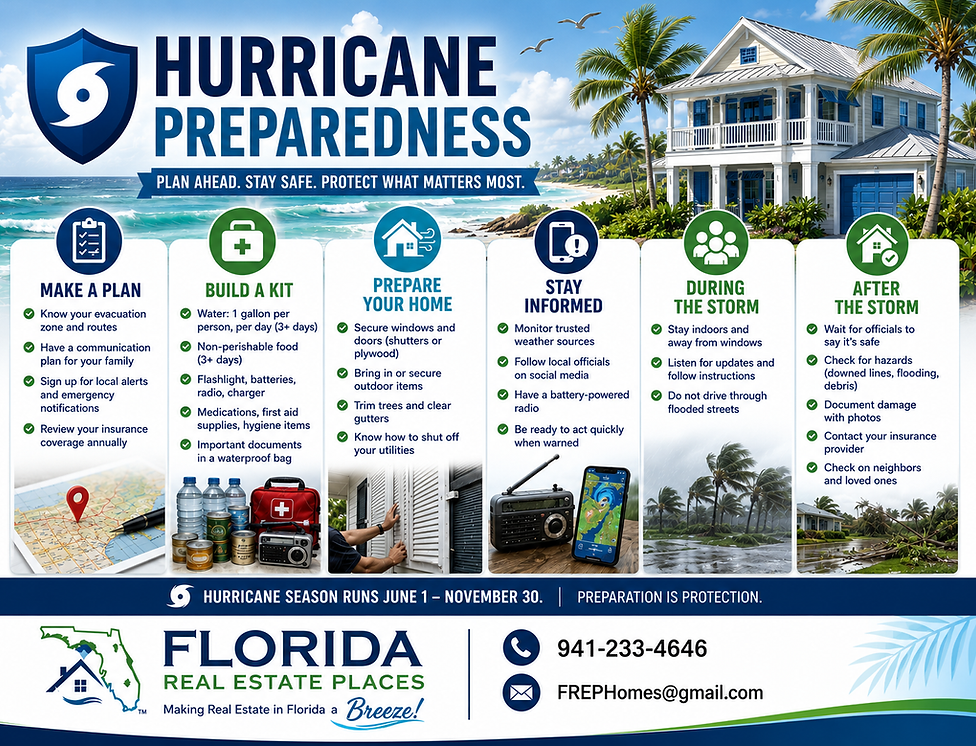
Living in Florida means embracing one of the most beautiful coastlines in the world — and preparing for the season that comes with it. Hurricane season runs from June 1 through November 30, with peak activity typically occurring between August and October. Whether you are a year-round Sarasota resident, a vacation homeowner in the Disney corridor, or a buyer considering a Florida purchase for the first time, understanding how to prepare your home and your family before a storm arrives is one of the most important things you can do. Preparation is not panic — it is confidence. And in Florida, it is simply part of the lifestyle.
Florida has weathered some of the most powerful storms in recorded history, and the communities along its Gulf Coast know better than anyone that resilience is not built in the hours before landfall — it is built in the months before the season even begins. The Sarasota and Manatee County coastline, with its barrier islands, shallow bays, and low-lying neighborhoods, sits in a geography that demands respect when storm systems develop in the Gulf. But here is what three decades of living and working in this market has taught us: the homeowners who fare best are not the ones who got lucky with a storm's track — they are the ones who were ready regardless of where it went. They knew their zone. Their shutters were installed. Their insurance was current. Their family had a plan. Hurricane preparedness is not a one-time checklist you complete and forget — it is a rhythm that becomes second nature when Florida is your home. And once it does, it changes nothing about the joy of living here. The sunsets are still extraordinary. The water is still warm. The lifestyle is still everything you came for. You simply enjoy all of it with the quiet confidence of someone who knows exactly what to do when the season demands it.
PROTECT YOUR PROPERTY - BEFORE THE STORM
When a hurricane is bearing down on the Florida coast, the window for meaningful action closes faster than most homeowners expect. The time to protect your property is not when the cone appears on the forecast map — it is weeks and months before the storm has a name. A well-prepared home does not happen in an afternoon. It is the result of deliberate decisions made during the quiet of the off-season: the inspection scheduled, the shutters tested, the trees trimmed, the garage door assessed, the yard cleared of everything that wind can turn into a weapon. Every improvement you make to your home's storm readiness before June 1 is an investment that pays in two directions — it reduces your risk when a storm arrives, and it often reduces your insurance premium in the meantime. The five areas below deserve your attention before the season begins, in the order of impact they carry when conditions deteriorate.
HURRICANE SHUTTERS AND IMPACT WINDOWS
The single most effective structural protection for a Florida home is impact-resistant windows and doors or properly installed hurricane shutters. If your home does not have impact glass, accordion shutters, or panel shutters, make sure you know where your panels are stored and that every opening is accounted for. A partial shutter job leaves your home vulnerable. Practice installing them before season so there are no surprises under pressure.
ROOF CONDITION AND STRAPS
Your roof is your home's first line of defense. Have it inspected annually, and after any significant weather event. Homes built after 2002 in Florida are required to meet stronger wind mitigation standards, but older homes may lack hurricane straps or clips that connect the roof structure to the walls. A licensed wind mitigation inspector can assess your home and produce a wind mitigation report — which can also lower your insurance premium significantly.
GARAGE DOORS
Garage doors are one of the most common points of failure in a hurricane. If your garage door is not rated for hurricane winds, a pressure surge can collapse it inward, allowing wind to enter the structure and dramatically increase the risk of roof failure. Brace kits are available for existing doors, and replacement with a rated door is worth the investment for coastal homeowners.
YARD AND OUTDOOR ITEMS
Everything that is not bolted down becomes a projectile in hurricane-force winds. Patio furniture, potted plants, decorative items, trampolines, and grills should all be brought inside or secured well before a storm arrives. Do not wait until the morning of — once bands begin, conditions deteriorate faster than forecasts often predict.
TREES AND LANDSCAPING
Have mature trees professionally assessed and trimmed before season. Overhanging branches, dead wood, and trees with shallow root systems in saturated soil are significant risks to your roof, your vehicles, and your neighbors' property. Document the condition of your landscaping with photographs before the season begins.
Contact Us Today!


IF YOU HAVE A VACATION HOME OR SHORT-TERM RENTAL PROPERTY
Vacation homeowners and short-term rental operators in Florida carry a unique layer of responsibility. If your property is occupied by guests when a storm approaches, your obligation to communicate evacuation requirements and facilitate guest safety is both ethical and potentially legal. We recommend every vacation homeowner have a clear written hurricane policy in their rental agreement, a designated local property contact who can assess and secure the property when the owner is out of state, and a relationship with a licensed contractor for post-storm assessment and emergency repairs. Do not rely on a property management platform to notify your guests — take direct responsibility.

UNDERSTAND YOUR INSURANCE - BEFORE STORM SEASON BEGINS
Florida homeowners insurance is among the most complex in the country, and hurricane coverage is where most gaps are discovered — unfortunately, after a claim. Review your homeowners, flood, and windstorm policies with your insurance agent before June 1 every year. Confirm your coverage limits, understand your hurricane deductible — which in Florida is typically calculated as a percentage of your home's insured value rather than a flat dollar amount — and verify that your dwelling coverage reflects current replacement cost. Flood insurance carries a 30-day waiting period before it takes effect, which means purchasing a policy the week before a named storm is approaching does nothing. Do not discover your coverage gaps at the claims desk.
HOMEOWNERS INSURANCE
Florida homeowners insurance covers wind damage in most standard policies, but coverage terms, deductibles, and exclusions vary significantly by carrier. Florida hurricane deductibles are typically calculated as a percentage of your home's insured value — commonly 2% to 5% — rather than a flat dollar amount. On a $500,000 home, a 2% hurricane deductible means you absorb the first $10,000 of wind damage out of pocket before your policy pays.
FLOOD INSURANCE
Florida flood insurance is a separate policy entirely and is not included in standard homeowners coverage. It is administered primarily through FEMA's National Flood Insurance Program (NFIP) or private flood carriers. If your property is in a designated flood zone, your lender will require it. If you are outside a designated flood zone, it is still strongly worth considering — a significant percentage of flood claims come from properties outside high-risk zones. Flood insurance policies typically have a 30-day waiting period before they take effect, which means purchasing a policy the week before a storm is named does nothing.
WINDSTORM INSURANCE
Windstorm insurance may be required as a separate policy depending on your location and carrier. In some coastal areas of Florida, standard homeowners policies exclude windstorm coverage entirely, requiring a standalone windstorm policy through Citizens Property Insurance or a private carrier.
Review all three policies with your insurance agent before June 1 every year. Confirm your coverage limits, understand your deductibles, and verify that your dwelling coverage reflects current replacement cost — not the purchase price of your home.
PROTECT YOUR FAMILY
Protecting your home matters — but protecting the people inside it matters infinitely more. The difference between a family that weathers a hurricane with confidence and one that finds itself scrambling at the last minute almost always comes down to one thing: preparation that happened long before the storm was named. Evacuation orders move fast. Shelves empty faster. Knowing your zone, having your supplies ready, and having a plan your entire household understands before the season begins is the single greatest act of care you can offer the people you love. The sections below cover everything your family needs to be ready — not just for the storm itself, but for the days and sometimes weeks that follow it.
KNOW YOUR ZONE
EVACUATION LEVELS AND FLOOD RISK
Before anything else, every Florida homeowner needs to know their evacuation zone. Florida uses a lettered zone system — Zone A through Zone F in most counties — with Zone A representing the highest-risk areas closest to the coast. Your evacuation zone is determined by your property's location and its vulnerability to storm surge, which is the wall of water pushed inland by a hurricane's winds. Storm surge — not wind — is the leading cause of hurricane-related deaths in Florida, and it can affect areas miles from the shoreline.
To find your zone, visit your county's emergency management website. For Sarasota County homeowners, the Sarasota County Emergency Management portal provides an interactive map where you can enter your address and identify your zone, flood plain designation, and nearest shelter location. Knowing this information before June 1 — not the night before a storm makes landfall — is the standard we recommend to every client.
IF YOU ARE EVACUATING — DO THIS BEFORE YOU LEAVE
Leaving your home ahead of a storm is the right decision when your zone is under an evacuation order. Do not let attachment to property override sound judgment. Before you go:
-
Take photographs and video of every room, every valuable, and the exterior of your home for insurance documentation purposes
-
Upload those images to cloud storage immediately
-
Turn off electricity at the main breaker if flooding is possible
-
Turn off propane tanks and natural gas at the source
-
Fill your bathtub with water for flushing toilets in the event water service is disrupted upon return
-
Lock all windows and doors
-
Leave a note inside your home with your contact information and destination for emergency responders
-
Notify a trusted neighbor or family member of your evacuation plan and expected route
AFTER THE STORM — RETURNING SAFELY
Do not return to your home until local authorities have declared the area safe for re-entry. Floodwaters, downed power lines, compromised structures, and gas leaks present serious hazards that are not always visible. When you do return:
-
Document all damage immediately with photographs and video before any cleanup begins
-
Contact your insurance carrier to open a claim as soon as possible — the earlier you file, the earlier an adjuster is assigned
-
Be cautious of unlicensed contractors who appear door to door after storms — contractor fraud following hurricanes is a significant and recurring problem in Florida
-
Verify contractor licenses at MyFloridaLicense.com before signing any repair agreement
-
Do not sign an Assignment of Benefits (AOB) agreement without fully understanding what rights you are transferring to the contractor

PREPARE YOUR FAMILY - THE ESSENTIALS
72-HOUR SUPPLY MINIMUM - SEVEN DAYS PREFERRED
Emergency management professionals now recommend a minimum seven-day supply of essentials for Florida residents given the potential for extended power outages following a major storm. Your supply list should include:
-
Water: one gallon per person per day, plus additional for pets
-
Non-perishable food and a manual can opener
-
Prescription medications — a 30-day supply if possible
-
First aid kit
-
Flashlights, batteries, and battery-powered or hand-crank radio
-
Portable phone chargers and backup power banks fully charged
-
Cash in small bills — ATMs and card readers go offline after storms
-
Important documents in a waterproof container or uploaded to secure cloud storage
-
Fuel — fill your vehicle tank when a watch is issued, not when a warning is declared
GENERATOR SAFETY
Generators save lives and prevent enormous property damage from food loss and sump pump failure — but they also kill people every year through carbon monoxide poisoning. Never operate a generator inside a garage, carport, or within 20 feet of a window or door. Invest in a carbon monoxide detector if you plan to use a generator, and review safe operating guidelines before you need them.
PETS
It is ILLEGAL in Florida to abandon a pet during a hurricane, however, not all emergency shelters accept pets. Identify pet-friendly shelters or boarding facilities in your area before season begins. Have your pet's vaccination records, medications, food, and a carrier ready to go as part of your evacuation kit.
HURRICANE PREPAREDNESS CHECKLIST
BEFORE SEASON (BY JUNE 1)
-
Confirm your evacuation zone and nearest shelter
-
Review all insurance policies — homeowners, flood, and windstorm
-
Inspect roof, shutters, windows, and garage door
-
Trim trees and remove dead branches
-
Assemble or refresh your seven-day supply kit
-
Charge all backup power banks and test generator
-
Photograph home interior and exterior for insurance records
-
Identify pet-friendly shelter or boarding option
WHEN A WATCH IS ISSUED
-
Fill vehicle fuel tank
-
Withdraw cash in small bills
-
Refill prescriptions to 30-day supply
-
Install hurricane shutters or prepare panels
-
Bring all outdoor items inside or secure them
-
Confirm evacuation route and destination
WHEN A WARNING IS ISSUED
-
Execute evacuation if in Zone A, B, or C
-
Turn off electricity, gas, and propane before leaving
-
Fill bathtub with water
-
Upload insurance photos to cloud storage
-
Notify family and neighbors of your plan
-
Lock all windows and doors
AFTER THE STORM
-
Wait for official all-clear before returning
-
Document all damage before cleanup
-
File insurance claim immediately
-
Verify contractor licenses before signing anything
-
Do not sign AOB agreements without legal guidance

WE ARE HERE - BEFORE, DURING, AND AFTER
Our commitment to the families and investors we serve does not begin and end at the closing table. When a storm is approaching, we are in this community — and we take that seriously. If you have questions about how hurricane preparedness affects your home's value, your insurance obligations, your flood zone designation, or your decision to buy or sell in a coastal Florida market, we are here for that conversation. Call us at 941-233-4646 or email FREPHomes@gmail.com. We have been navigating Florida real estate through storm seasons since 1992 — and we know this market, this coastline, and this community well.
HURRICANE RESOURCES
The best time to find a resource is before you need it. Bookmark these links now, share them with your household, and revisit them at the start of every season. Having the right information at your fingertips before a storm develops is one of the simplest and most effective preparations you can make.
SARASOTA COUNTY HURRICANE RESOURCES


MANATEE COUNTY HURRICANE RESOURCES



OSCEOLA COUNTY HURRICANE RESOURCES


LAKE COUNTY HURRICANE RESOURCES


POLK COUNTY HURRICANE RESOURCES


STATE OF FLORIDA HURRICANE RESOURCES


FEDERAL HURRICANE RESOURCES


INSURANCE HURRICANE RESOURCES
-
Florida Division of Emergency Management — floridadisaster.org
-
Florida Department of Financial Services (insurance guidance) — myfloridacfo.com
-
Verify Contractor Licenses — myfloridalicense.com
-
Florida 511 Road Conditions — fl511.com
-
National Hurricane Center — nhc.noaa.gov
-
FEMA Flood Map Service Center — msc.fema.gov
-
National Weather Service — weather.gov
-
Ready.gov Hurricane Preparedness — ready.gov/hurricanes
-
Citizens Property Insurance — citizensfla.com
-
FEMA National Flood Insurance Program — floodsmart.gov
-
Florida Office of Insurance Regulation — floir.com